The Rafay Family Murders

So much about this story reminds me of the Menendez murders. We have to go across Lake Washington because most of it took place in Bellevue, but it's so close to Seattle, I'm including it. Here's a shot of the Bellevue skyline from where I live.
In the spring of 1994, Tariq Rafay, his wife, Sultana, and their daughter, Basma moved to Bellevue from Vancouver, B.C. The couple's son, Atif, was a sophomore at Cornell University in Ithaca, New York. During the following summer, Atif was visiting his friend, Sebastian Burns up in West Vancouver. The first week of that July, they both took a bus to Bellevue to visit Atif's family. They were there less than a week when, on July 13th, Sebastian called 911 from the Rafays' kitchen phone at 2 am. In a panic, he told the dispatcher there had been "some kind of break-in" and that his friend's parents were dead. When police arrived at 4610 144th Place SE they found what appeared to be a staged break-in.
Rafay Home today
Sultana had been unpacking boxes in the basement and didn't even know what hit her. She was struck twice in the head with a heavy, blunt object and was found face down on the carpet with a bloody shawl over her head. Police figured she was attacked first. Tariq was in bed asleep when he was repeatedly struck in the head and face. He was beaten so badly he was almost unrecognizable. 20-year-old Basma was autistic and hadn't spoken a word since childhood. When police arrived, they could hear her moaning and found her lying against her bedroom door. Her arms were covered in bruises and the wall above her bed was crushed, apparently by blows that missed their mark. She died five hours later.
The Keg restaurant in Factoria
The state crime lab later determined the three were most likely killed with an aluminum baseball bat. A murder weapon has never been found. The two 18-year-old's told police they left the Rafay home at 8:30 pm July 12th. They ate dinner at The Keg in Bellevue's Factoria neighborhood at 3500 Factoria Blvd. SE. They then watched "The Lion King" across the street at The Factoria Cinemas. (They were supposedly avid film buffs)
Cinemas at 3505 Factoria Blvd. SE
From there, they headed to Seattle and stopped by the nightclub, The Weathered Wall at 1921 5th Avenue under the monorail. They were turned away because the club was closing. They said they then returned to Bellevue and found the bodies. Witnesses remembered seeing the two at all locations.

 Former Weathered Wall Club (yellow)

At first, police considered their alibis to be airtight but they later said the two had more than enough time between the movie and the trip downtown, to commit the murders. Their theory was that Atif and Sebastian wanted to cash in on the half-million dollars the Rafay's were worth. Considering what the house must have looked like, the police put the two up in a dingy Bellevue motel. Although they weren't suspects, the cops were growing suspicious. Three days later, with nothing for cops to hold them on, they went back to Canada and started spending the Rafay's money. On July 20th, a notice appeared in the Seattle Times saying, "Bellevue police would like to talk to anyone who saw the late show of The Lion King at the Factoria Cinema on July 12, 1994. Purely routine." It was six months before Bellevue police officially named the two as suspects. Then, in early 1995, the Royal Canadian Mounted Police gave help and began investigating the two on suspicion to commit murder and fraud. They launched "Operation Estate," an elaborate, five-month sting in which undercover detectives posed as high-rolling mobsters in an effort to gain confessions and DNA samples. Detectives worked to entice the two into a world of organized crime with the promise of two-hundred-thousand-dollars for a film they wanted to produce. The RCMP bugged the house Atif and Sebastian shared and stole their car to plant a listening device in it. The police recorded four-thousand hours of audio and video taped conversations, including what seemed to be confessions from both men. Canadian police made their arrest on July 31, 1995. King County filed murder charges that same day. Canada agreed to extradite the two only if the US took the death penalty off the table. After almost six years of legalities, they were finally booked into the King County Jail in March of 2001. The trial was delayed numerous times for various reasons, including one small controversy. On August 10, 2002, two guards outside a King County Jail conference room saw 26-year-old Burns standing behind his 43-year-old attorney, Theresa Olson, with his pants down and his penis erect.
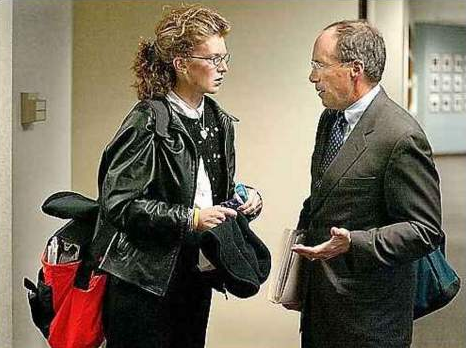
Theresa Olson with her attorney
Her long dress was pulled up around her waist, court papers said. She was removed as council and suspended from The Washington Bar Association for two years. The trial began on November 23, 2003. Prosecutors argued that while "defendant Rafay watched and disconnected the VCR, defendant Burns beat the victims to death with a baseball bat." They believed Burns did this in his underwear to avoid getting bloodstains on his clothes. He then took the bat into the shower with him. The defense argued undercover Canadian detectives coerced and threatened Rafay and Burns into making false admissions. They also said neighbors reported hearing sounds that could have been the thuds of a baseball bat from the Rafay home at a time the defendants were confirmed to be elsewhere. (I've been to the neighborhood and that seems very unlikely. These are large homes on big lots.) On May 26, 2004 (My birthday) Sebastian and Atif were each convicted of three counts of first-degree murder. At sentencing, Sebastian (who is incredibly pompous) rattled on for an hour and a half about how he was innocent. Atif said he couldn't believe "the shoddy lie" they told undercover Canadian police about how they were responsible for the murders - "has misled so many people and eclipsed the real evidence in this case." He also said, "I'm tormented by the fact. . . my parents' killers walk with impunity." They were each sentenced to three consecutive life sentences. Atif went to the Washington State Reformatory in Monroe where he teaches high school to inmates.
Sebastian and Atif  after sentencing
Sebastian's had a hard time of it at the Pen in Walla Walla. He's jailed with violent, long-term offenders where he's had many a crisis, including assaults by inmates and the force-feeding of food and anti-psychotic medications because of mental-health problems. In 2007, Sebastian's film-maker sister, Tiffany, produced the documentary, Mr. Big about her brothers arrest, trial, and her belief in his innocence. The Rafay's are all buried in Snohomish, Washington. RIP

Starvation Heights

This is one of the most disturbing stories I’ve ever heard. Linda Burfield Hazzard was an osteopathic nurse on the Kitsap Peninsula who referred to herself as a doctor.
Despite not having a medical degree, she was licensed to practice medicine due to a loophole in a law that grandfathered in practitioners of alternative medicine. She was also able to convince many patients that starvation could cure almost any ailment they might be suffering. She even wrote a book called Fasting for the Cure of Disease.
 
Not surprisingly, most of her patients died. At least the ones with money did. Her “sanitarium” in Olalla was nicknamed Starvation Heights by the locals, who sometimes came across skeletal escapees staggering down the road begging for food. Linda’s husband, Sam was a West Point graduate who ruined his career by stealing money from the Army. He was also a drunk and a swindler. Linda put him in charge of stealing money from her patients. This whole operation started back in Minnesota, where Linda was born and raised. After leaving her first husband and two children to pursue her dreams in Minneapolis, she opened her first clinic there in 1902 and started killing people. Linda said disease could be cured by fasting and allowing the digestive system to “rest” and be “cleansed,” “removing impurities from the body.” Fasting, she said, could cure anything from a toothache to tuberculosis. The real source of all disease was “impure blood” brought on by “impaired digestion.” She was obviously crazy, and more than likely an undiagnosed serial killer. Her regime included daily enemas that went on for hours and involved up to twelve quarts of water. Patients were heard crying out in pain during the procedure. The third part of her therapy was a massage that consisted of her beating her fists against the patients’ foreheads and backs. One witness reported her doing this while shouting “Eliminate! Eliminate!” Her first patient died around the time her divorce became final. After the coroner determined that death was caused by starvation, he tried to get her prosecuted, but since she wasn’t licensed to practice medicine, she wasn’t held accountable. When investigators asked what happened to the victim’s valuables, Linda was evasive. She met and married Sam later that year but he hadn't bothered to divorce his second wife.

Northern Bank and Trust Bldg
He did two years in jail for that and after he got out in 1906, Linda suggested they move out west to start over. She set up shop at the Northern Bank and Trust Building at 1500 4th Avenue and commuted across the Sound to their home at 12541 Orchard Avenue in Olalla. She purchased 40 acres and before the locals gave it it's moniker, she called it Wilderness Heights.

Hazzard Home in Olalla
She had grand plans to build a large sanitarium on the property. Her first known Seattle victim was Daisey Haglund, a Norwegian whose immigrant parents owned the land which is now Alki Point. After a 50-day fast under Linda’s direction, she died on February 26, 1908, at the age of 38. She left behind a 3 year-old son named Ivar.
Alki Point
Yep, Ivar Haglund, the “Flounder” of Ivar’s Restaurant’s. (I recommend the Scallop’s ‘n Chips and the Red Clam Chowder) His mother left him a house at 3045 64th Avenue SW. It’s the oldest house in Seattle. Other victims soon followed; Ida Wilcox in 1908, Blanche Tindall and Viola Heaton in 1909, and Mrs. Maude Whitney in 1910.
Haglund's Historic House
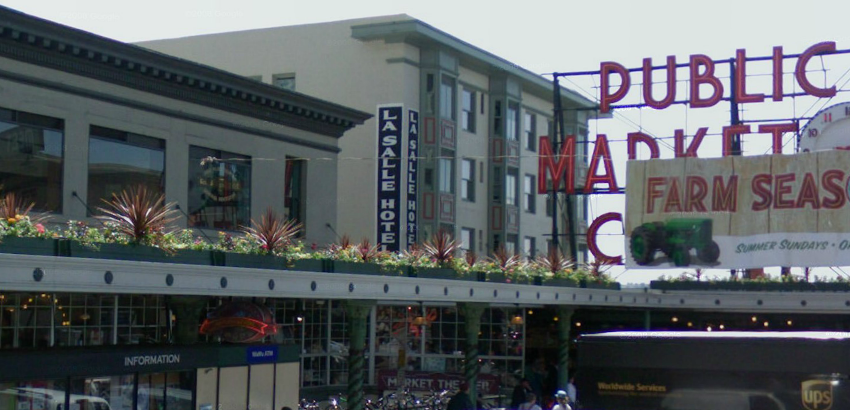
When civil engineer Earl Erdman died in 1911, The Seattle Daily Times headline read “Woman M.D Kills Another Patient.” But patients kept on coming. Frank Southard, a law partner, and C.A. Harrison, publisher of Alaska-Yukon magazine, died under Linda’s care later that year, along with Ivan Flux, an Englishman who had come to America to buy a ranch and who had fasted for 53 days. During his fast, Linda gained control of some of his cash and property, and his family was told he died with only 70 dollars left to his name. Authorities tried to step in when Lewis Rader, a former legislator and publisher of a magazine called Sound Views, began wasting away. Linda treated him at the Outlook Hotel at Pike Place. (Now the LaSalle Hotel) 

LaSalle Hotel at Pike Place
Health inspectors tried to convince him to leave but he refused. Linda hid him away in a secret location where the 5-foot, 11-inch tall man died weighing less than a hundred pounds. The health director of Seattle said he couldn’t intervene, since “Dr.” Hazzard was licensed and the patients were willing participants in her deadly therapy. But he did keep an eye on her in case she treated any children, at which point he said he’d step in. When 26-year old Eugene Wakelin’s decomposing body was found on the Hazzard’s property with a bullet in his head, many speculated he'd been shot by the Hazzards, who were frustrated to learn that despite his aristocratic family, he wasn’t rich. Well, Dorothea and Claire Williamson, two British sisters in their early 30s, were rich. While visiting Victoria BC, they read an advertisement for Linda’s book in a Seattle newspaper. Although there was no indication that either of them was sick, they decided to go and take the fasting cure. In February of 1911, they visited Linda at her office and were told that the sanitarium wasn’t ready yet, but that she would treat them in Seattle. The sisters were put up at the Buena Vista Apartments at 1633 Boylston on Capitol Hill.
Buena Vista Apartments
They survived mostly on a thin vegetable broth. Linda would show up regularly to provide the enemas and massages. She also began to make inquiries about the sisters’ business affairs, and offered to store the women’s diamond rings and real estate deeds in her office safe. (How nice) By April, the sisters were near death and delirious. They were transferred to Olalla by twin ambulances and a private ferry launch. Just before the ambulance set out for the dock, Linda’s attorney obtained a shaky signature from Claire leaving a monthly stipend of 25 pounds sterling per year to the Hazzard’s “Institute.” On April 30, the sisters’ childhood nanny, Margaret Conway, received a telegram, summoning her to visit them in Olalla. She arrived from Sydney a week later. Sam Hazzard met and took Margaret to Linda’s office. There, she was told that Claire was dead and Dorothea was insane. Then, she was taken to Olalla for a reunion with Dorothea who was by now a human skeleton living alone in a cabin no better than a shack. Dorothea immediately begged to be taken away, but the next day she changed her mind and insisted that the cure was doing her a world of good. (Curing what?) Margaret stayed there hoping to convince her to leave. At a Fourth of July celebration, two patients approached Margaret and begged her to get them out the place, saying they were prisoners. When she announced that she would be leaving and taking Dorothea with her, Linda said Dorothea wasn’t free to leave. The Hazzards had obtained legal guardianship of her. They said she would be spending the rest of her life with them. Margaret sneaked off the property to contact the sisters’ uncle in Portland, and he came to the rescue. Dorothea now weighed 60 pounds. The Hazzards presented her with a bill for $2,000 and said they wouldn’t allow her to leave without some cash. Her uncle negotiated a smaller ransom. The British vice-consul in Tacoma put pressure on Kitsap County to prosecute Hazzard. When they said they couldn’t afford it, Dorothea Williamson offered to pay for everything. In August of 1911, Linda Hazzard was arrested. The Tacoma Daily News headline read: “Officials Expect to Expose Starvation Atrocities: Dr. Hazzard Depicted as Fiend.” Linda said she was being persecuted because she was a successful woman, and that traditional doctors resented her success and opposed natural cures. She told reporters “I intend to get on the stand and show up that bunch. They’ve been playing checkers but it’s my move. I’ll show them a thing or two when I get on the stand.” Her lawyer kept her off the stand, and the judge scolded her for signaling to witnesses. On top of damning medical testimony, a complete paper trail, including a forged diary entry saying Claire wanted Linda to have her diamonds, made it clear the Hazzards were crooks. The jury came back with a verdict of manslaughter. Linda managed to kill two more patients while awaiting sentencing. She got  two years and did her time at Walla Walla. She and Sam then moved to New Zealand, where she operated under the titles of physician, dietitian, and osteopath. She also published another book, and made a lot of money.
Only Known Picture of the Sanitarium
By 1920, she had enough money to come back to Olalla and build her dream sanitarium at Starvation Heights. Since the state of Washington had pulled her medical license, she called it “a school of health.” The lavish building included a basement autopsy room and an incinerator. Although she didn't have the amount of patients she had anticipated, people still checked in to be starved. The sanitarium burned down in 1935, and three years later, Linda died. She hadn’t been feeling well and embarked on a fasting cure. (Poetic Justice) The total number of her victims is unknown, but she can safely be said to have starved at least a dozen people. RIP

U Dub Reacts to Kent State Killings

In his bid for the Presidency in 1968, Nixon promised to bring troops home from Vietnam and end the feud with Southeast Asia. On April 30, 1970, he sent U.S. forces into Cambodia which only widened the battlefield. (Crook) Protests began all over the country and especially on college campuses.
Odegaard (With megaphone) addresses students
On May 4th, National Guardsmen fired on a demonstration at Kent State University in Ohio, killing four students and wounding nine. The actions of those Guardsmen triggered a nationwide student strike that forced hundreds of colleges and universities to close. U Dub was no exception. Student activists called for a strike on May 4th, and the next day's rally on campus turned into an impromptu march on the freeway to downtown Seattle. The inaugural strike demonstration  began at 10:30 am in front of the Husky Union Building at 4001 Stevens Way. 
In front of HUB
There, striking students and faculty overwhelmingly approved a list of demands to be presented to the administration, including a pledge by University President Charles Odegaard to never call National Guard troops onto the campus. (Seems reasonable) After a long march through campus, the strikers arrived at the Administration Building (Schmitz Hall at 1400 NE Campus Parkway) around noon. There, Odegaard expressed outrage over the Kent State killings, but refused the strikers’ demands.
Marching Down 45th
In response, the students voted to begin marching off campus and through the U District. 7,000 strikers hit “The Ave.” and when they reached NE 45th Street they began chanting “Freeway! Freeway!” They all headed for I-5. They reached the freeway around 1:50 pm, but somehow lost about 2,000 marchers. (In 8 blocks?) Still 5,000 strong, they flooded onto I-5 and began marching south towards downtown. Traffic was backed up for miles for about an hour.

Entering I-5 at 45th
People who were there say many motorists honked and flashed peace signs in approval. Barely a mile down the freeway, about 30 riot-clad Troopers were waiting for them at the Roanoke St. exit. The marchers voted to leave the freeway and continue south on Eastlake Avenue, which parallels the freeway. 
View from Roanoke Overpass
They eventually reached the King County Courthouse at 1010 5th Ave. around 4 pm, where they were joined by striking students from several other local colleges and high schools for an hour-long rally. The next day another march took place down I-5 but University students walked south through the Montlake neighborhood and down through the Central District and entered the freeway at Cherry Street.

Old King County Courthouse
They headed north and were met with tear gas and billy clubs and were forced from the freeway. There were a few arrests and of course some of the cops used too much force, but what happened back on campus the next day was crazy. On the morning of the 7th, protesters had attempted to close the University by blocking the entrance gates with anything they could find.
May 6th March
Campus Police would clear the entrances only to have them blocked again. By that afternoon, thousands of protesters had taken to the campus and Campus PD was completely overwhelmed. Their jurisdiction includes many of the streets surrounding the campus and a few off-campus apartment buildings. Seattle Police Officers had been watching but didn’t encroach on Campus PD territory until protesters began pummeling Campus Officers
with rocks at the 40th Street gate.
Gate at 40th and 15th Today
City cops on the campus triggered a riot on the streets of the U District. (SPD territory) Windows were smashed out of First Interstate Bank on the corner of 45th and University. (Now Wells Fargo) Trash cans were set on fire and flying rocks and bottles injured
a lot of people.
45th and University Today
Reports began to come in to Campus PD about vigilantes beating people on "Hippie Hill" (Parrington Lawn) at 15th and NE 42nd. Campus Officers ran up to the hill with riot batons and saw a group of white males in civilian clothes all spread out in a line. The men were carrying sticks and moving south. People were on the ground injured.
Parrington Lawn Today
One woman tending to a man with a head injury pointed to the men saying that they were beating people. Officers approached the men and ordered them to drop the clubs. "We're police officers" one of the men said. He reached into his pocket and produced a Seattle Police badge. They had reportedly been sent onto the campus “to beat some hippies.” 
Terry-Lander Hall Today
Other vigilante cops broke into Terry-Lander Hall at 1101 NE Campus Parkway claiming they were chasing rioters. According to witnesses, they beat “anyone they saw with long hair." Nobody had any idea they were cops. The actual strike really didn’t start until the 10th and it lasted until the 18th. It sort of became lost during the protests and rallies. Here’s a link to more info about it. On May 19, Acting Chief Moore admitted that a platoon of the Tactical Squad was present in the U District that night. They had been changing clothes at the police station when the call came in to go back on duty. (LOL) That was a blatant lie because the same thing had already happened during civil rights protests in the Central District. (Seattle Police Chiefs have a problem telling the truth)
Coming Home
On June 3, 1970, after the tactic became public, Seattle Police Major Ray Carroll became the “fall guy” and was demoted and transferred for his "overreaction" in commanding the officers. By the end of 1970, roughly 200,000 soldiers had returned home from Vietnam. Of the remaining 350,000, those who survived would all be home by the beginning of 1974. The United States lost roughly 58,000 soldiers during the war. RIP

The "Postal" John

In 1993, a postal worker named Jim Fiori lived alone in an apartment on the South slope of Queen Anne. He worked the night shift sorting mail at Seattle's main post office at 301 Union Street. He was described by neighbors and co-workers as quiet, meek, and a bit of a loner. One of his neighbors, an elderly woman, couldn't seem to get over the fact that despite his exquisite view of the city, he never opened his curtains. "Does that make sense to you?" she asked reporters. (Yes lady, he worked the night shift.) 

Post Office at 301 Union St.
The 47-year-old was never married, had no kids, few friends, and had no female companions that anyone could remember. Except for the prostitutes he frequented on Aurora Ave. The lucky lady he picked up on the night of July 17th was Alane Scott. She was a 28-year-old mother of four, who had lost them all to the state. She had no home, no car, no possessions. But she did have a raging heroin addiction. She’d also been in and out of the clink on numerous prostitution, theft, and drug charges. With that said, she in no way deserved what happened to her. Jim picked her up around 9:30 in front of the Thunderbird Motel at 4521 Aurora Ave. (It was demolished on February 29, 2012)

4521 Aurora Ave.
They drove back to his apartment at 518 Prospect and negotiated a romantic evening for a price of 70 dollars. At some point afterward, Jim decided to take a shower and Alane decided to go through his jacket.

She found an envelope full of cash and as she was rifling through it, Jim came out of the bathroom. When he saw what was happening he grabbed a kitchen knife and stabbed her in the chest. Then he strangled her. Surviving that, she made her way for the door. Jim grabbed a gun from a drawer, tackled Alane, put a pillow over her head and pulled the trigger. Then, he put her in his bath tub and left her there for almost a day. In whatever state of mind he was in, he figured the best idea was to dismember her with an axe. (This is my second post about an axe murder on Queen Anne hill. There’s a third one coming.)
518 Prospect today
After severing her head and right arm, he loaded the pieces into his Ford Fiesta and went looking for somewhere to get rid of them. Patrolman Lance Ramsay had been cruising North Seattle the night of the 18th when he noticed an erratic driver and pulled him over. His notes said the driver was "Nervous, fidgety, and would not look at me." "There was blood on the driver’s hands, steering wheel, and the outside of the hatch." The driver gave some excuse about cleaning fish and the cop let him go. He’s not a total idiot though, he jotted down the license number. The next morning Seattle woke up to the headline "Naked, Headless Woman's Body Found in Street". Jim had dumped Alane at the intersection of Roosevelt and Densmore on a quiet residential street in the Haller Lake neighborhood.
N. Roosevelt and Densmore
She was noticed around dawn on the 19th. When word of the body spread through the police department, Ramsay passed along the license plate number and detectives paid a visit to Jim Fiori. He calmly invited them in. He hadn’t even bothered to clean the blood on the carpet, or discard the weapons used to commit the murder. After giving the detective’s excuses about the blood nobody would ever believe, they hauled Jim in. The next question they wanted to know was where the rest of Alane was. Jim told them he put her head and arm into a dumpster by Green Lake. (I don’t know which one) By the time detectives got to the dumpster, the contents were on the way to a land-fill in Oregon. After an extensive search, the rest of the body was never recovered. Jim said the years of frustration, isolation and anxiety collided with his anger at Alane and he “finally erupted like Mount St. Helens." He plead guilty and received 27 years. RIP Alane.